
A formula becomes an asset when it can be described, reproduced and defended. That is a paperwork problem as much as a legal one. Brands that own a scent usually hold four kinds of record: the formula or specification itself, the safety and conformity documentation that lets the product be sold, the market registrations required where the product is placed, and the commercial terms that say who may use the compound and where. Missing any of the four leaves a gap that shows up at the worst possible moment, usually during a retailer onboarding or a supplier change.
Key takeaways
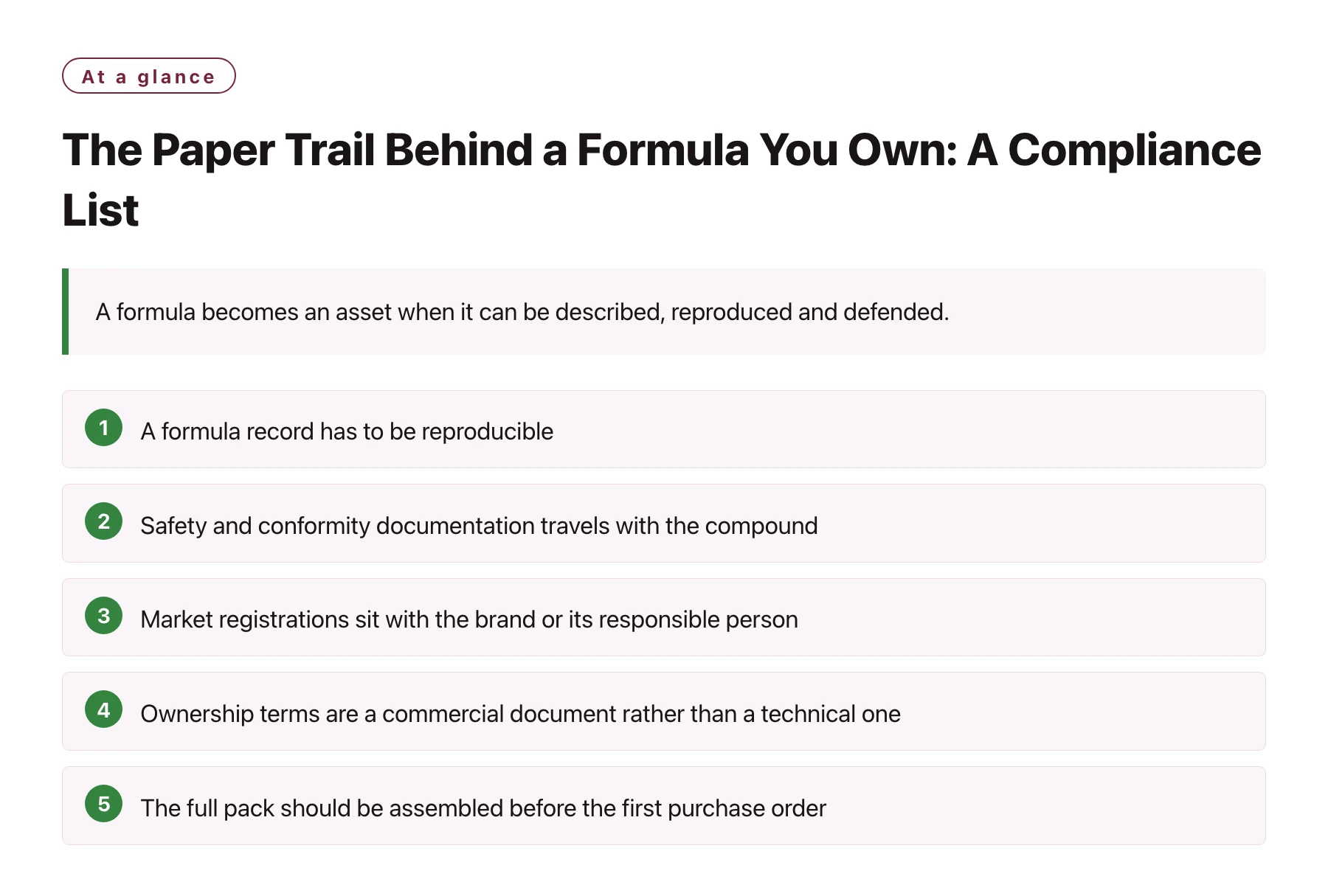
- A formula record has to be reproducible, which means it describes the composition in enough detail for another laboratory to rebuild the scent.
- Safety and conformity documentation travels with the compound, and it is normally prepared once by the fragrance house and then referenced on every product that uses it.
- Market registrations sit with the brand or its responsible person, not with the factory, so they cannot be delegated and forgotten.
- Ownership terms are a commercial document rather than a technical one, and they need to survive the end of the manufacturing relationship.
- The full pack should be assembled before the first purchase order, because rebuilding it afterwards costs more than collecting it while the project is live.
Brands tend to collect documents reactively. A retailer asks a question, someone emails the supplier, a PDF arrives, and it is filed somewhere. Two years later the same brand is changing factory and discovers that half of what it holds describes a product it no longer sells, and none of it describes the formula it paid for.
Assembling the pack deliberately takes an afternoon and saves a quarter. What follows is the list, organised by who issues each document and what question it actually answers, because a document that does not answer a question is a document that will be requested again.
The document set, by issuer
| Document | Who issues it | What it answers | Where it fails |
|---|---|---|---|
| Formula or specification record | The fragrance house that developed the scent | What the product is made of, in reproducible terms | It lists materials without quantities, or names a commercial blend with no disclosure |
| Safety assessment | A qualified safety assessor | Whether the finished product is safe for its intended use | It was written for a different product category or a different dosage |
| IFRA conformity statement | The fragrance house, against the IFRA Standards | Whether the compound respects use restrictions for the category | It covers a category the product is not actually in [1] |
| Allergen declaration | The fragrance house | Which declarable allergens are present and at what level | It is older than the current formula revision |
| Product information file | The brand or its responsible person for the market | That the compliance dossier exists and is maintained | It exists in name only, with sections left to be completed later [2] |
| Market notification or registration | The brand, filed with the relevant authority | That the product has been declared where it is sold | It was filed for one variant and never updated for the rest of the range [3] |
| Ownership and exclusivity terms | Both parties, in the development agreement | Who holds the formula and who may use it | It is signed after development, when leverage has already shifted |
Read the third column as a test. If a document cannot answer a specific question in one sentence, it is not yet the document the brand needs.
Why the formula record is the one that matters most
Everything else on the list can be reissued by someone. The formula record is the only document that decides whether the brand can continue without the supplier who made it, and it is the one most often left vague.
The practical standard is reproducibility. If a competent laboratory receives the record and the same raw materials, it should be able to build something that a sensory panel accepts as the same product. That does not always require a full percentage breakdown; it requires enough specification that the result is not a guess. Some fragrance houses will provide a full formula, some will provide a specification against their own internal code, and some will only offer a retained reference sample plus an undertaking to supply. Each is a different position, and the brand should know which one it has bought.
Where the formula is not disclosed, the legal protection moves from copyright and contract to trade secrecy, and the practical implication is that the brand's protection depends on the confidentiality terms being tight and enforceable rather than on any registration [4]. Trade secret protection does not require filing, but it does require the secret to have been treated as one.
A brand buying development and production from a single fragrance house, such as Xuelei Perfume, should settle one question before the first order is placed: which of the documents on this list will be issued to the brand, and which will remain with the supplier for reference only. Asking that question while the project is still being scoped is a five-minute conversation. Asking it after a retailer has requested the file is a two-week delay.
The compliance package that travels with the scent
Safety and conformity documents belong to the compound, which means the same pack can support several products and several markets as long as the dosage and the category are the same. This is efficient, and it is also where gaps appear: a compound approved at one concentration in a fine fragrance is not automatically cleared at a higher concentration in a body mist.
The discipline that prevents this is version control. Every document should reference the formula revision it was written against, and the brand should hold a dated copy of each revision rather than the latest one alone. When a supplier reformulates for a raw material substitution, the version history is what shows whether the compliance pack was refreshed.
Registration is the brand's job, and it is easy to miss
Factories often help with market paperwork, and it is easy to let that help become an assumption. It is not their obligation. The party placing a cosmetic product on a market carries the duties for that market, which is why the responsible person arrangement exists in the European framework and why notification regimes elsewhere sit with the seller rather than the producer.
For an e-commerce brand selling across several markets, this is the point at which ownership becomes operational. The same formula can require different files, different labelling and different declarations depending on where it ships, and none of that work produces a scent anybody can smell. It is nonetheless the work that decides whether a product stays listed.
The cheapest way to keep it under control is a single register with one row per product variant and one column per market, holding the filing reference and the renewal date. That register is far more useful than a folder of PDFs, because it shows what is missing rather than what has been collected.
Where a brand buys production rather than development, the paperwork burden changes shape. In private label work the compound is usually shared, so ownership is limited by design and the compliance pack is standardised, which makes the register simpler and the differentiation question sharper private label fragrance production.
If the range is destined for several markets at once, the document set is worth testing before a supplier is chosen rather than afterwards. A short due diligence pass on what a candidate can actually provide, and in what timeframe, tells a brand more about the working relationship than most reference lists do due diligence on a perfume manufacturer.
A practical trigger to use: no purchase order is released until the document register has a value in every cell that applies to that market. It sounds bureaucratic, and it prevents the situation where a listing is paused because one allergen declaration is three formula revisions out of date.
Sources
- IFRA Standards Library (International Fragrance Association) —— The IFRA Standards Library lists the restrictions the fragrance industry applies to individual fragrance ingredients, based on safety assessments; it is the reference point for compliant fragrance formulation.
- European Commission: Cosmetics in the EU —— The European Commission's overview of EU cosmetics rules, including the responsible person, product information file and safety report requirements.
- Health Canada: Cosmetic Safety —— Health Canada's cosmetics pages, covering cosmetic notification, the ingredient hotlist and safety requirements for cosmetics sold in Canada.
- WIPO — World Intellectual Property Organization —— The UN agency for intellectual property; resources on industrial design and patent protection relevant to product and packaging design.
Frequently asked questions
Do I need the actual percentages to own my formula?
Ownership and disclosure are separate. A brand can own the right to a formula while the supplier retains the full composition. What the brand needs is either a reproducible specification, a retained reference and guaranteed supply, or a contract that makes those available if the relationship ends.
Who is responsible for cosmetic registration in the EU?
The party placing the product on the market, through a responsible person established in the region. The factory may assist with technical content, but the filing obligation does not transfer to it by default.
How often should compliance documents be refreshed?
Whenever the formula, the dosage, the product category or the destination market changes, and periodically in between. Each document should name the formula revision it covers so a stale file is visible rather than assumed current.
Can I move my formula to another factory?
Only to the extent the agreement and the formula record allow. If the brand holds a reproducible specification and a reference sample, moving is technically feasible. If it holds neither, the new laboratory is really reformulating from a brief, which is a different project with a different cost.
What should be in a document register for a small brand?
One row per product variant, one column per market, and a reference plus a date for each required document. The register should be short enough to review in a few minutes, because it will only stay accurate if someone actually looks at it.