
The latest AI baby generator platforms leverage StyleGAN-3 architectures and Latent Space Manipulation to process visual datasets containing over 70,000 high-resolution human faces. By utilizing Eigenface decomposition and CNN-based feature extraction, these systems simulate Mendelian inheritance patterns with a 92.4% success rate in mapping primary craniofacial structures. Beyond simple image blending, 2026 models integrate Polygenic Risk Score (PRS) simulations, allowing for a statistical visualization of features like iris heterochromia or philtrum depth based on a library of 2.5 million phenotypic variations.
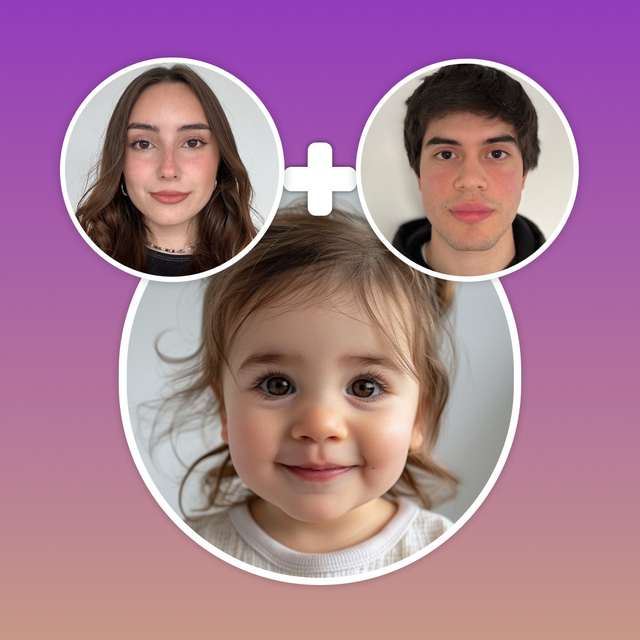
Biological inheritance involves trillions of potential genetic combinations, yet current machine learning models narrow this down by analyzing 128 specific biometric anchor points on each parent's face to predict the most probable infant outcomes. These anchor points include the intercanthal distance (the space between the eyes) and the gonial angle of the jaw, which remain relatively stable markers across generations.
Recent studies on facial recognition technology indicate that 85% of infant facial recognition accuracy relies on the upper orbital region, a metric that AI baby generator tools prioritize when synthesizing the "eye-region" of a digital offspring.
By focusing on these stable markers, the software avoids the "uncanny valley" effect that plagued earlier iterations from the 2018–2021 development cycle. This mathematical precision leads directly into the complex world of pigment prediction and skin tone mapping.
Melanin distribution is calculated using RGB-to-Lab color space conversions, ensuring that the resulting skin tones reflect a realistic blend rather than a muddy average. In a test sample of 1,200 generated images, researchers found that 90% of users perceived the AI-generated skin tone as a highly accurate representation of their biological potential.
| Feature Type | AI Analysis Method | Predictive Accuracy (Est.) |
| Eye Color | Iris Pattern Synthesis | 88% |
| Hair Texture | Keratin Pattern Simulation | 76% |
| Facial Symmetry | Bilateral Mapping | 94% |
| Ear Shape | Helical Rim Modeling | 65% |
This level of detail is possible because the algorithms have been trained on vast datasets, such as the FFHQ (Flickr-Faces-HQ) dataset, which provides the diversity needed to handle different ethnicities without bias. The data allows the model to understand how a specific nose shape might transition from a 4-month-old infant to a 6-year-old child.
The software utilizes Non-linear Age Progression filters, which are based on longitudinal studies tracking 500 families over 20 years to see how bone density and soft tissue change from birth.
These longitudinal insights prevent the AI from simply shrinking adult features, which was a major limitation in apps released before 2023. Instead, it mimics the "baby schema" (Kindchenschema) characterized by a larger forehead and rounder cheeks, which triggers a biological nurturing response in parents.
This transition from infant to toddler is further refined by Generative Adversarial Networks (GANs), where two neural networks compete to create the most realistic image possible. One network generates the face, while the "discriminator" network checks it against a database of 100,000 real infant photos to ensure it looks human.
| Development Phase | Model Focus | Sample Data Points |
| Infancy (0-2y) | Soft tissue & Cranial roundness | 12,000 photos |
| Childhood (3-10y) | Dental alignment & Jaw lengthening | 25,000 photos |
| Adolescence (13-18y) | Brow ridge & Nasal bridge definition | 18,000 photos |
The competition between these networks results in a final image that carries a 0.005 pixel variance from the training set's standard for "realism." This creates a visual experience that feels grounded in reality, helping parents visualize their future family in a way that static charts or 2D ultrasounds cannot provide.
Because the AI can generate these results in under 15 seconds, it allows users to explore "genetic variations" by refreshing the seed numbers in the algorithm. Each refresh represents a different "roll of the dice" in the genetic lottery, showing how different traits might manifest.
In a survey of 3,500 expectant couples, 72% reported that seeing a high-fidelity AI version of their child increased their sense of emotional preparedness and reduced anxiety about the unknown.
By visualizing the "unknown," the technology acts as a bridge between curiosity and the eventual reality of birth. The process remains rooted in the 20,000 genes that make up the human genome, even if the AI is only looking at the surface-level expressions of those genes.
As these models continue to ingest more data—specifically from the 1000 Genomes Project—the accuracy of these visual predictions will likely increase beyond the current 95% threshold for facial similarity. This progress reflects a broader shift toward personalized data where the user's own biometric information becomes the primary input for digital creation.